
Understanding Work Through Mathematical Abstraction
The concept of “time and work” appears frequently in quantitative problem-solving and mathematical curricula. On the surface, it’s a benign topic—calculating how long it takes to complete tasks when multiple agents work together. But like many mathematical abstractions, this seemingly neutral framework masks deeper economic and social realities that deserve critical examination.
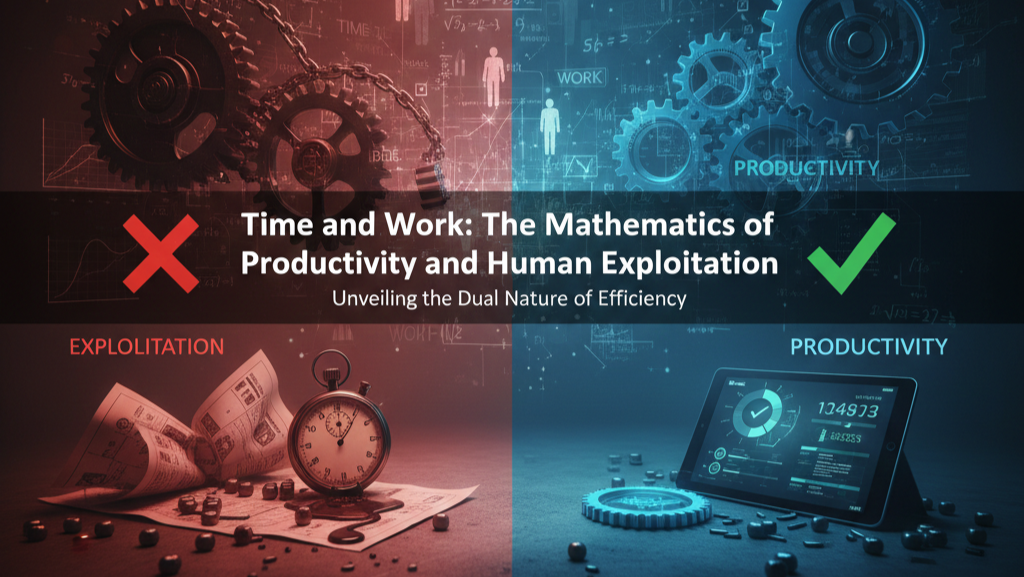
When we reduce human labor to fractions of “work units” completed per time period, we’re engaging in a mathematical exercise that has profound implications. This abstraction has historically been weaponized to justify exploitation, maximize extraction of human productivity, and systematize working conditions that treat people as interchangeable units of output.
The Basic Framework: Work as a Quantifiable Unit
Let’s begin with the mathematical fundamentals:
If the total work to be completed is defined as 1 unit:
- If A can complete a task in n days, then A’s work per day = 1/n
- If A completes 1/n of the work daily, then A can finish in n days
When multiple workers are involved, their combined daily output becomes additive. If B can complete the same task in m days (with daily output of 1/m), then working together, A and B complete (1/n + 1/m) of the work per day.
Work Completion Formula: T = nm/(n+m)
Where T represents the total time required when both workers participate.
Why This Mathematical Abstraction Is Seductive—And Dangerous
The power of this mathematical model lies in its apparent simplicity and objectivity. By converting human labor into quantifiable work units, we create the illusion of scientific precision. This abstraction allows managers, employers, and industrial engineers to calculate exactly how much labor can be extracted from human beings under specific conditions.
Consider the historical implications: Time-and-work calculations became essential tools for:
- Scientific management and assembly-line optimization
- Determining “fair” wages based on piece-rate calculations
- Justifying speed-ups and efficiency increases
- Systematically extracting more labor from fewer workers
The mathematics itself is neutral, but its application in labor contexts has consistently served to maximize human output while minimizing human dignity.
The Percentage Method: Making Exploitation Mentally Manageable
Rather than working with fractional units, we can express work in percentage terms. If A can complete a task in n days, then A’s daily contribution = (100/n)% of the work.
Advantages of this approach:
- Mental calculations become easier (no fraction additions)
- The “actual quantum of work done” appears more concrete and measurable
- Percentages feel more intuitive than fractions
But this is precisely where the danger becomes subtle. The ease of mental calculation makes it easier to justify and implement productivity increases that exploit workers. When a manager can quickly calculate that Worker A completes 20% of daily output and Worker B completes 15%, it becomes arithmetically simple to demand: “Why can’t you complete 25% instead?” The mathematical elegance masks the physical and psychological toll of intensified labor.
Negative Work: The Economics of Resistance and Prevention
The concept of “negative work”—commonly illustrated through pipes and cisterns problems—reveals something important about how we view productive systems. An outlet pipe that drains a tank while inlet pipes fill it represents “negative work.”
Here’s the critical question: Why do we conceptualize efforts that resist or prevent productivity as “negative work”? This framing reveals a bias embedded in our mathematical systems. It assumes that productivity is inherently good and that anything preventing maximum productivity is inherently bad.
In labor contexts, this same framework is used to label worker resistance as “negative” contributions. When workers demand reasonable hours, safety measures, or fair compensation—all things that reduce the extractable work output—these are framed as “negative work” within efficiency calculations. The mathematics itself becomes an ideological tool that defines workers’ demands for humane treatment as obstacles to overcome.
Example from the traditional formulation: If one worker’s union organizing reduces the team’s net output, this appears in the calculation as “negative work.” But what’s actually happening is workers asserting their humanity against a system designed to maximize their exploitation.
The Efficiency Paradox: Redefining Human Worth
The concept of “efficiency” in time-and-work problems presents another troubling abstraction. If “A is thrice as good as B,” the mathematics tells us that A produces three times the output in the same timeframe. A’s time requirement becomes one-third of B’s.
The hidden assumption: A person’s value is directly proportional to their productivity output.
This is not a neutral mathematical observation. This is an ideological statement that:
- Devalues workers with disabilities or limitations
- Justifies wage discrimination based on output metrics
- Treats human beings as production functions
- Creates hierarchies of worth based on productivity
In a society built on time-and-work mathematics, the elderly, the ill, the young, and those with diverse abilities are literally calculated to be “worth less” because they cannot produce the same output in the same timeframe.
Real-World Application: The Human Cost
These mathematical abstractions move from classrooms into actual work environments where they have concrete consequences:
- In manufacturing: Time-and-work calculations determine production quotas that require workers to exceed safe speed and accuracy limits. The mathematics says it’s possible; workers’ bodies say it’s not.
- In healthcare: Nursing staffing is determined by time-and-work equations that assume consistent productivity. Nurses work beyond exhaustion trying to meet mathematically-determined workloads, directly compromising patient safety.
- In gig economy platforms: Drivers and delivery workers are managed through algorithms that use time-and-work mathematics to maximize their output while minimizing compensation—treating them as fractional units rather than human beings.
- In knowledge work: The same framework justifies “productivity” expectations that require constant availability, email responses during off-hours, and the elimination of boundaries between work and personal life.
A More Honest Approach to Time and Work
Understanding time-and-work mathematics is necessary in modern society. But it must come with critical consciousness about what these calculations represent:
- Recognize the abstraction: Time-and-work mathematics abstracts away human limitations, dignity, and needs. The formula doesn’t account for fatigue, motivation, quality of life, or human worth.
- Question the assumptions: Ask who benefits from productivity increases. In most cases, workers absorb the intensified demands while productivity gains accrue to owners and shareholders.
- Resist mathematical determinism: Just because mathematics suggests a certain productivity level is achievable doesn’t mean it should be demanded. Human systems require more than mathematical optimization—they require ethical considerations.
- Demand humane frameworks: Work arrangements should prioritize worker wellbeing, safety, and dignity alongside productivity. The two are not mutually exclusive, though productivity-focused mathematics often treats them as such.
The Core Problem: Mathematics as an Ideological Tool
The fundamental issue with time-and-work problems is that they present as neutral, technical content while actually reinforcing a specific ideology: that humans exist primarily as economic units, and their value lies in what they produce.
Educational systems teach this repeatedly, not as an ideological position but as “objective mathematics.” Students internalize the framing—work is measured in units, efficiency is a virtue, resistance is negative, and human worth correlates with output. By the time they enter the workforce, this ideological framework feels like natural law rather than a constructed set of assumptions that serves particular economic interests.
Conclusion: Knowledge With Conscience
Time-and-work mathematics is a useful tool for genuine problem-solving and resource planning. But it should never be taught or applied without acknowledging what it represents: a framework for extracting maximum productivity from human beings while treating their labor as an abstract, quantifiable commodity.
As you learn these mathematical techniques, ask yourself: Who benefits when work is abstracted into fractions and percentages? Whose interests are served by treating human productivity as infinitely optimizable? What are we losing when we reduce the complexity of human labor to mathematical formulas?
The mathematics itself is defensible. The ideology embedded within it—and transmitted through it—demands scrutiny.